Current TRG vs GPS Statistics
last update: Sun Jun 1 02:00:59 JST 2003
Plots of last 24 hours
from 05-30-2003 17:00:35 to 05-31-2003 17:00:31 (UTC)

Relative time between spills (via TRG 48-bit clock)


same as above, but zoomed in [2.17 ... 2.21] and with histogram
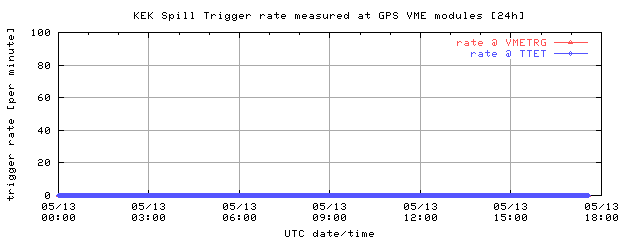
Spill rate measured via GPS1 (blue) and TRG (red)
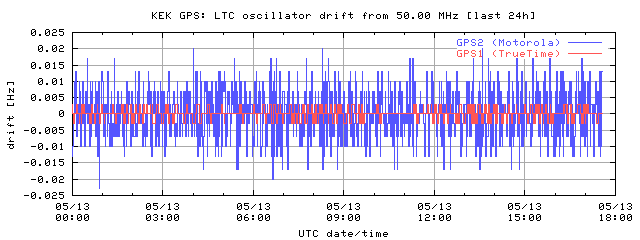
LTC oscillator drift from 50 MHz (*1)

TRG oscillator drift from 50 MHz (*1)

Absolute spill time difference between GPS1 and GPS2

Relative spill time difference between GPS1 and TRG (*2)

Relative spill time difference between GPS2 and TRG (*2)
Plots of last 7 days
from 05-24-2003 00:00:58 to 05-31-2003 16:59:59 (UTC)

Relative time between spills (via TRG 48-bit clock)


same as above, but zoomed in [2.17 ... 2.21] and with histogram
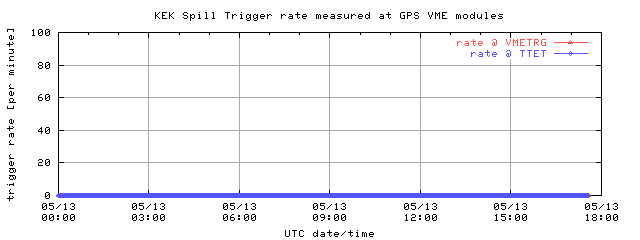
Spill rate measured via GPS1 (blue) and TRG (red)

LTC oscillator drift from 50 MHz (*1)

TRG oscillator drift from 50 MHz (*1)

Absolute spill time difference between GPS1 and GPS2

Relative spill time difference between GPS1 and TRG (*2)

Relative spill time difference between GPS2 and TRG (*2)
Histograms
Note: y axis is log scale!


Notes
| (*1) | Both, the TRG module and LTC module each use an internal, free-running 50 MHz crystal oscillator (independent) for their clock counters. The two oscillators are not temperature compensated! Therefore, any change of the room temperature in the North Hall control room causes them to drift. Cooler temperatures usually result in higher frquencies than at warmer temperatures. |
| (*2) | Absolute TRG clock vs. GPS time measurements cannot be made due to the mentioned temperature-dependent TRG oscillator drifts, as shown in the wave forms of the plots above. The waves are inverse proportional to temperature changes in the North Hall. |
See also list of errors