
NuInt01 :
The First International Workshop on
Neutrino-Nucleus Interactions in the Few GeV Region
December 13-16, 2001, KEK, Tsukuba, Japan
List of participants(PDF)
 The proceedings of the
workshop will be published in Nuclear Physics B - Proceedings Supplement
in fall, 2002.
The proceedings of the
workshop will be published in Nuclear Physics B - Proceedings Supplement
in fall, 2002.
They are available on-line from this page by coutesy of the Publisher (Elsevier):
Click Proceedings/Slides
tag in the left menu. (March 6, 2002, Upd. Aug 21, 2002)
-
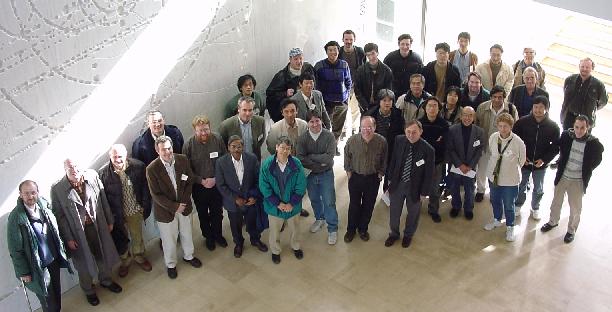
Workshop photos: Click
Photo tag in the left menu. (December 25, 2001)
-
Slides in PDF format: Click
Program/Slide tag in the left menu. (December 22, 2001)
HIGHLIGHT OF THE WORKSHOP AND
ANNOUNCEMENT FOR THE NEXT NUINT02
University of California, Irvine, Dec.12-15, 2002
The early strong indication of muon-neutrino oscillations in atmospheric
neutrinos by the Super-Kamiokande (SK) experiment inspired several proposals
for neutrino oscillation experiments using conventional low-energy neutrino
beams. By the time these indications had become the discovery of neutrino
oscillations by the SK collaboration, several of these experiments were
already in the construction phase. Since then, the K2K long-baseline
neutrino oscillation experiment, using a neutrino beam with <E_nu> = 1.3 GeV
interacting with nuclei in the Super-K detector, has already taken data for
2 years. The NuMI / MINOS project at Fermilab and the CNGS project at CERN
are under construction and expecting to begin taking data within the next
2 - 4 years. These experiments are designed to improve the precision of the
measurements of neutrino oscillation parameters. In addition, the
short-baseline MiniBooNe experiment at Fermilab is on-schedule to begin
data-taking this summer.
As these experiments accumulate increasingly-large data sets, the
contribution of systematic errors will become more significant in the
oscillation analysis. Important sources of these systematic errors are the
uncertainty in the neutrino-nucleus cross sections and subsequent nuclear
effects in the few GeV energy region such as Fermi motion, Pauli blocking,
nucleon binding, nuclear correlation, shadowing, the "EMC" effect and
final-state interactions. To better understand these sources as they apply
to neutrino scattering will be essential for the K2K, MiniBooNe, MINOS and
CNGS experiments as well as the planned neutrino oscillation experiments at
JHF-Kamioka, future atmospheric neutrino experiments and next generation
proton-decay experiments. Considering the above situation, the organizers
believed it was a propitious time to organize an international workshop on
this subject.
The Workshop has been very successful. About 68 participants, equally
from Asia, US / Canada and Europe, attended this Workshop. Additional
participation was arranged via international video conferencing for the
presentations in the Monte Carlo session. Consequently, these Proceedings
contain a very complete review of the theoretical and experimental status of
neutrino-nucleus interactions in the few GeV region. The results from this
Workshop are already being used and discussed in the present neutrino
experiments like K2K and NuTeV. In addition, a strong
community of nuclear and high-energy physicists has been formed in order to
meet the many challenges in current neutrino physics. A joint nuclear /
high-energy physics proposal to experiment in the new high-intensity
neutrino beams at FNAL is a good indication of the success of this venture.
To report on progress made and to re-examine the status of this field,
the Second International Workshop on Neutrino-Nucleus Interactions in the
few GeV Region (NuInt02) has now been scheduled for December 2002 in Irvine,
California. The topics will include the following subjects:
- Neutrino-nucleus interactions, and their relation to
neutrino oscillations, proton decay studies and astrophysics
- Review of electron-nucleus interactions
and neutrino-nucleus interactions
- Theoretical review of low energy neutrino-nucleon
interactions and nuclear effects
- Comparison of neutrino event generators
- Future experiments for precise neutrino-nucleus interactions
We hope that this Workshop will maintain its
unique feature to develop the neutrino-nucleus interactions
and contribute to the development of this field.
Organizing and Program Committee
